Good news - lots of workshop time today. Bad news - nope, not tellin' ya about it. On the other hand I've got the okay on a couple of things from Mr Nicholas Blake (see previous on carpenter's stores etc), but I shall save the best for Monday (Mondays need something to sweeten them). In the meantime, anyone want to speculate on the identity of the saw in this incident? Resolution was apparently in Nootka Sound (on the coast of Vancouver Island - and yes, I had to look that up...) in April 1778 and one of the natives
"had nearly got off with a double cross cut saw, used by the carpenters ashore, which he had contrived to twist around his body, and hide under his clothes so ingeniously as almost to avoid suspicion"
Naturally I've made an educated (I'd like to think) guess but if I'm correct it does make the mind boggle a little as to how he managed it. And which way would you have the teeth pointing...?
Oh, and I just know you're all dying for further oakum-toilet paper revelations. Apparently the guides on HMS Victory claim the oakum was hung above the tables at meals for wiping greasy hands on - and then subsequently used for the aforesaid purpose. Now I can recall being quite sceptical about some of the stories those guides put about when I went round Victory many years ago, the leg pull being a favourite hobby of many a nautical type, so take that as you will. I'm certainly not speculating on it - so far every avenue of thought has ended up requiring the delete button if this blog is to refrain from making the readership heave...

Saturday, October 28, 2006

Friday, October 27, 2006
Checked
Now I could tell you the latest workshop news, but Christmas looms on the horizon, a young galoot's thoughts turn to present-making and blogs have ears. So, in short, I can't. On the other hand I can tell you I now have a clean Stanley #10 bench rebate plane (and some spare parts) where there was only a clean but broken Stanley #10 bench rebate plane and a rusty but unbroken Stanley #10 bench rebate plane before. I'm really going to have make a couple of front knobs sooner rather than later though - a lovely rosewood tote currently being ruined by a flaky old stained beech knob is an abomination unto this galoot's eyes... Other than that, no matter where my thoughts turn, I find myself looking at proscribed topics. Sigh. It's a blighter being full of things to say and not being able to spill the beans for one reason or another. Maybe by Monday at least one thing may have been transferred to the allowed list? Fingers crossed and have a good weekend, y'all.
Thursday, October 26, 2006
Sawyer's Apprentice
Does the bi-annual replacement of the tensioning bolt on my old Elu bandsaw count as bona fide workshop time? For a change this time I had an apprentice to put me off, er, "help" - the old man's been custodian of the saw for a year and more now, so we figured he ought to learn how to do it. It's an Elu 3410 iirc - rebadged as a DeWalt these days (having been a DW before it was rebadged as Elu - what goes around comes around...) and apart from a lousy rip fence the blade tension bolt is the one serious failing it has.
The wallies at DeWally, bless 'em, elected to use a 150mm M6 carriage bolt and an ordinary nut to cope with the tension on the blade. Well it strips the thread on the bolt over time, doesn't it? About once every two years in fact. And DeWalt charge ten whole pounds sterling for a replacement. Naturally I only did that once before I learnt my lesson. Instead I did two things; first, the purchase of a connecting or double nut to help spread the load across more threads - luckily it fits easily in the tensioning knob.
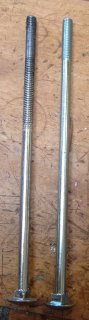
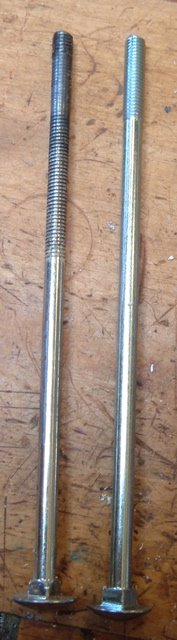
Secondly, should you find yourself in a similar situation, first purchase a 150mm long M6 carriage or coach bolt. Realise the threads as provided aren't long enough so thread them a little further with the correct size of die. You can see from the defunct bolt on the left it's the "proper" threads that give up, not the self-tapped ones.
The tricky bit is dismantling the bolt from the saw without having bearings and washers cascading about your ears. The blade is removed first, then you have to undo the tensioning knob while supporting the weight of the wheel and holding the bolt up in your other hand, and ultimately balancing the small tower of washers and bearing washers on top of the spring while you remove the tensioning knob before swiftly gathering up said tower before letting the bolt slip from the wheel. Whatever you do, you mustn't let the bolt drop out before you've corralled the washers or you'll be on your hands and knees looking for them for a week. Sound complicated? Believe me, it's much worse than it sounds...
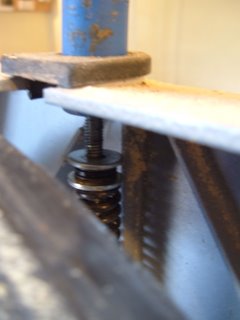
But possibly not as bad as putting it all together again... Generally I drop at least one thing as I do so - carefully feeding the washer/bearing tower piece by piece onto the bolt, gradually feeding it upwards as I also support the wheel's weight - and this time it was the tensioning knob. Usually that means dismantling everything again, bending down to retrieve the knob and starting again. Bless the apprentice - as is their purpose in life, he was there to pick it up for me! So instead of prolonged cursing it all went swimmingly first go, and the blade was tracking and the guides set up in no time. And best of all he gets to do it next time instead of me. Huzzah!
I reckon could get used to the idea of having an apprentice...
The wallies at DeWally, bless 'em, elected to use a 150mm M6 carriage bolt and an ordinary nut to cope with the tension on the blade. Well it strips the thread on the bolt over time, doesn't it? About once every two years in fact. And DeWalt charge ten whole pounds sterling for a replacement. Naturally I only did that once before I learnt my lesson. Instead I did two things; first, the purchase of a connecting or double nut to help spread the load across more threads - luckily it fits easily in the tensioning knob.
Secondly, should you find yourself in a similar situation, first purchase a 150mm long M6 carriage or coach bolt. Realise the threads as provided aren't long enough so thread them a little further with the correct size of die. You can see from the defunct bolt on the left it's the "proper" threads that give up, not the self-tapped ones.
The tricky bit is dismantling the bolt from the saw without having bearings and washers cascading about your ears. The blade is removed first, then you have to undo the tensioning knob while supporting the weight of the wheel and holding the bolt up in your other hand, and ultimately balancing the small tower of washers and bearing washers on top of the spring while you remove the tensioning knob before swiftly gathering up said tower before letting the bolt slip from the wheel. Whatever you do, you mustn't let the bolt drop out before you've corralled the washers or you'll be on your hands and knees looking for them for a week. Sound complicated? Believe me, it's much worse than it sounds...

But possibly not as bad as putting it all together again... Generally I drop at least one thing as I do so - carefully feeding the washer/bearing tower piece by piece onto the bolt, gradually feeding it upwards as I also support the wheel's weight - and this time it was the tensioning knob. Usually that means dismantling everything again, bending down to retrieve the knob and starting again. Bless the apprentice - as is their purpose in life, he was there to pick it up for me! So instead of prolonged cursing it all went swimmingly first go, and the blade was tracking and the guides set up in no time. And best of all he gets to do it next time instead of me. Huzzah!
I reckon could get used to the idea of having an apprentice...
Wednesday, October 25, 2006
19thC toilet paper and other mysteries
Further to my blatant looting of "Steering To Glory", I received an email from the author, Mr Nicholas Blake. Yes, trust me to be caught out being rude about a book title again - last time was David Charlesworth's... But no, your correspondent isn't about to be embroiled in legal action (at least not so far), but instead some rather interesting additional info has this way come from Mr Blake. I'm awaiting the nod or no on whether I may post most of it (better safe than sorry), but in case anyone else was as perplexed as me (hence the [?!]) as to the use of "junk axes" and "woolding nails"; apparently junk axes "were used to cut up old rope to be made either into oakum or into tows, for use as the equivalent of toilet paper." Which leads me down a whole different and disturbing road wondering about 19thC toilet paper... However... I sort of pictured all the axes that had seen better days were all kept for some purpose, "just in case". In fact I was thinking that Boatswain must have been a galoot to keep decrepit tools in his stores on the off-chance they'd come in handy, so a bit of a disappointment there. Apparently woolding nails were "used to secure the woolding rope used to support masts or yards that were either fished (broken) or made in pieces." Now that does ring a bell from one or other of the fictional escapades I've read over the years, so I'm quitely kicking myself at not remembering. But no matter. I wonder what their particular attribute was that made them especially suited for the task?
I must admit to thinking it's pretty damn cool to get personal footnotes like that, so very many thanks to Mr Blake. It gets better, but as I say, I don't want to jump the gun without checking first so let's just say I've been practicing my copperplate deciphering today...
Erm, yes... Deciphering copperplate equates to not going into the workshop I fear. Well it was raining buckets anyway - I'd have needed that boat I'm not making.
Subscribe to:
Posts (Atom)