Friday, December 07, 2012

Take Down

Ooo, some of you are very good at this, and fast too. On the other hand, I did catch out a fair few by duplicitously hinting at adjustability. We'll call it a score draw.

Yes, the mystery pic didn't show the parts fully "home" so I could lead you astray with thoughts of patented augers and such, but here it is, fully locked and not quite such a close up.

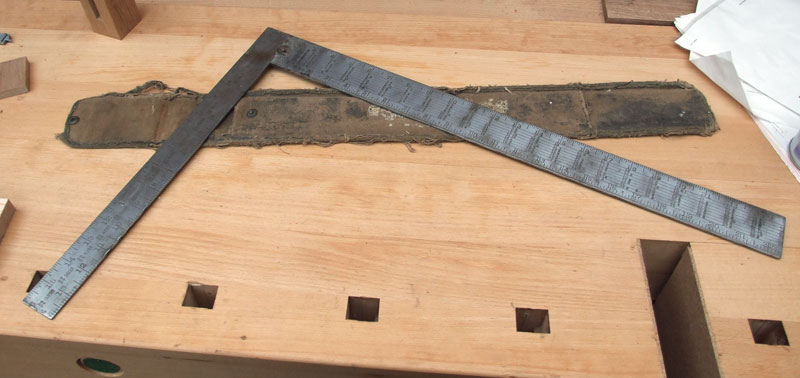
Zoom out a little more, and behold, it is, indeed, a "take-down" framing square. A cunning whizz that eliminated that ever-recurring problem for the framing square user - where to put the darn thing in the tool box. The dovetail slide and locking screw make it really very rigid and it's actually square. Even in this example, which has suffered more than a little in its life; alas, even with the helpful direction indicating arrow, someone tried to tighten it up the wrong way, and did Bad Things at some point. Jeff saved me a lot of time with his correct guess, by also providing a link to the patent - much obliged, Jeff!

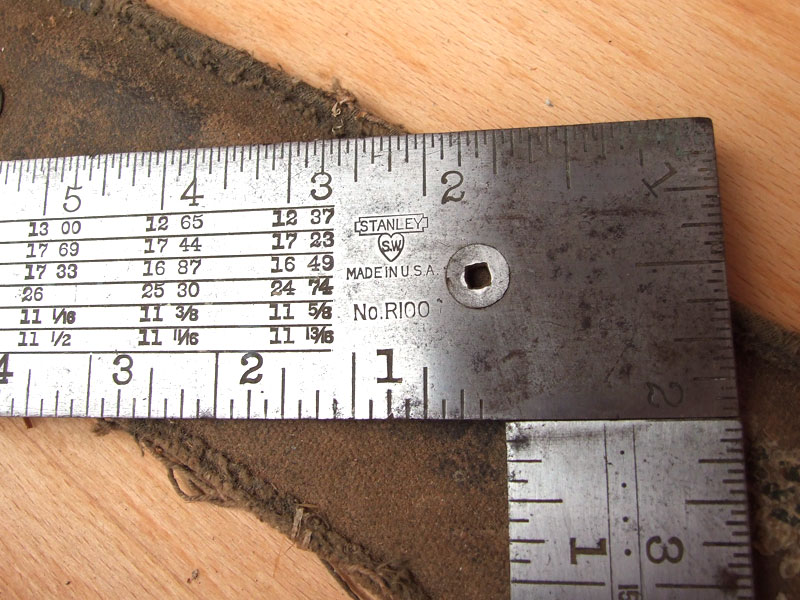
Once again, it was one of the former owners of the Newlyn Tool Chest who spared no expense and went for the top of the range from Stanley; a No. R100TD. And it really was an expensive choice; according to the September 1937 "MAC" catalogue, they cost a hefty 26/6 each. An equivalent fixed Stanley square in the same catalogue was a mere 15/-. For the benefit of Americans and anyone else for whom the shilling is a closed book, a 1920s Stanley USA catalogue shows $5.05 and $2.70 respectively. Basically, it's nearer twice as much as not, so no wonder you don't see them much.

The Stanley Little Big Book tells me it was made between 1919-1947 (presumably starting around when Eagle Square was swallowed by Stanley?), and that the key and canvas sack are frequently missing. The Old Tool Archive suggests one half of the square can often be missing too. Well anyway, I have the sack, albeit rather the worse for wear.

But from the state of the slot on the locking screw, you've probably guessed that I don't have the key, and it was lost long before I acquired the square. There's a little pocket in between the two long ones for the arms wherein the key was, I imagine, intended to live. Sad.

Perhaps I've never been tuned to noticing them, but I don't recall seeing framing squares much at all round these parts (right-angles in Cornish buildings aren't really much of a thing), so it seems doubly unlikely that of all the framing squares in all the world, this apparently atypical example should wend its way into my w'shop. I kinda like it, although I've never used it and in all likelihood never shall. Although maybe if it had a replacement key or key-substitute, I might... Where's the To Do List?

#46758594: Make key for take-down square.

Le sigh.

Anyway, now you car boot and flea market types know to start looking out for ratty canvas pouches now as well as more obvious rust - you never know what you might find inside. And thanks for for playing along and taking a guess!

Thursday, December 06, 2012

Tool-oholic Teaser

Okay, I admit it; this one is an utterly premeditated teaser. I'm evil that way. Also, I'm interested to see who, if anyone, will know/guess it. So have at it in the comments and make your best guess; I'll refrain from clearing comments for publication until I blog the answer.

Y'know, looking at it again, it's possible this may be too easy...

Wednesday, December 05, 2012

We'll Need Considerably Bigger Buns

So, this 'ere plane then. Colloquially known as an "infill" or, sometimes, as a "heavy sonofa-".

This example is 9" long, a full 2 5/8" wide casting (no dovetails here), with a hefty 2 1/4" Thomas Ibbotson & Co. tapered iron. Stuffed, I believe, with rosewood. Weight is... heavy. I haven't put it on the scales, but you certainly wouldn't want to drop it on your foot. Or even pick it up much, to be honest.

And before you ask, yes, those are spots of rust. No exclamation from you about it will compare with the curses I directed at myself when I saw them. It has been an exceedingly wet year, but still... Horrors.

Now, whilst Mr A was spending his formative years learning to be a joiner and offending his mother with talk of "stuff", there was a Mr H. W. "Harry" Harrison also labouring in the workshop. Whether he was a Harold or Henry, I don't know; mayhap he was a Hubert, Horace, or Horatio and the "Harry" came about merely from his surname. History is silent on the matter. Whatever his given name, my notes from conversation with Mr A tell me he passed away in 1950, which is probably when Mr A came into possession of this beast. Now my notes also tell me that Mr A was born in 1930, so how he afforded such a thing at such a young age, we can but speculate. Maybe it went cheaply because, at some tragic point, its nose had hit the w'shop floor and broken off the unusually curly front bun.

At least it's unusual to me; I've never seen one like it. But possibly this is the moment to confess that my interest in infills is... lacking. Quintessentially British tool evolution it may be, but I can't get excited about them hardly at all. So odds are heavily in favour of someone reading this being able to tell a lot more about it than I ever will. Feel free to share, if you do.

F'rinstance, the expert may look at this lever cap and be able to tell you who's catalogue Harry ordered it from. For Harry is said to have made it, and honestly, apart from the vulnerable choice of front bun design, he made a pretty damn good fist of it.

Which brings about a question in my mind; joinery does not usually conjure up infill planes and rosewood. It's more windows, doors, stairs, maybe some mahogany? So I wonder what Harry had been doing in earlier years? Perhaps advancing age meant he could no longer do the cabinetwork he'd done in his prime? Or maybe the post-war era just needed more joiners than infill-weilders? No idea, but I can't help speculating. Go on, try and stop me.

You can see how far down the top of the iron rests against the rear handle; it's a well worn tapered iron, and as a result the mouth is considerably more open than modern tastes would like to see. And probably traditional tastes too. I love the neat fit of the infill into the casting at the heel, and the handle itself looks shapely enough...

But really no picture could possibly convey just how uncomfortable I find it. Oh, I see you rolling your eyes and muttering about "Alf and her handles" again, and yeah, perhaps. But in the search for the perfect finish I reckon Harry thinned the thickness of the handle down too far, and it bites a bit. Otherwise, you can see it's a pretty roomy grip, which is not always the case with old tools.

So that's the only infill bench plane in my possession. Occasionally I think I should probably sell it to someone who'd appreciate it more, but then I think I really ought to have one (British and all, old boy, what, what), and I'm never likely to acquire another, and any financial gain is likely to be far smaller than the nagging dissatisfaction I'd have about selling it. So, I keep it. In theory I know about 3000% more about how to make it go than I did ten years ago when I acquired it, so maybe I'll have another go at it some time and see if the scales fall and I gain a better appreciation of why folks get so excited by infills.

Tuesday, December 04, 2012

Filler-In

Promise on my combi plane c*ll*ct**n, I did not intend to drag this out this much, but so-called real life will insist on getting in the way... Dropping this one to keep the Tool-oholics from suffering DTs, and will explain all I know (not much), and hopefully get further pictures edited and uploaded tomorrow. Don't throw things; this one was trimmed and fluffed for your delectation at 4am this morning to ensure at least something would appear, so it's not like I've not been thinking of you ;)